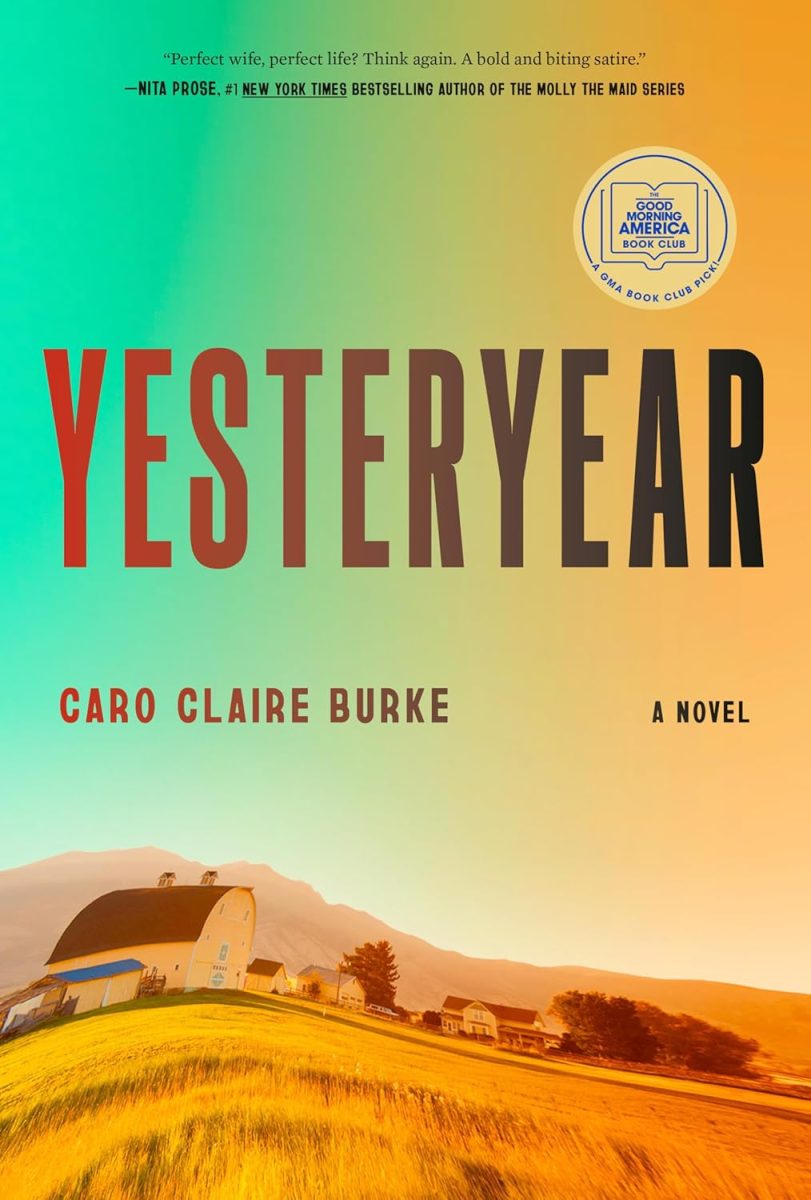
“Yesteryear,” the debut novel of author Caro Claire Burke, skillfully plays into both the humor and the tragedy of the tradwife influencer trapped in a world she helped construct. The book was released in April 2026 and immediately topped the New York Times Best Sellers List. A movie adaptation starring Anne Hathaway is also already in the works.
The story follows Natalie, a woman who prides herself on her family’s traditional Christian values. Natalie makes her living as a social media influencer, with content involving her five children and the farm she lives on. One day, Natalie wakes up on a farm similar to the one she calls home, except in the year 1855. Her husband and children have transformed into strange people she hardly recognizes. Natalie must learn to cope with her new life in a world that seems like a distorted version of the one she once commanded.
The book alternates between flashbacks that paint Natalie’s past and her new life in the 1800s. Over the course of the story, the narrative pieces together how Natalie moved through life and how she ended up where she did.
In recent years, social media accounts promoting strict conservative traditionalism have risen to prominence. Influencers like the Ballerina Farm and Nara Smith have cultivated millions of followers by showcasing themselves, raising children, completing chores and cooking meals. These women are often called “tradwives,” a term coined for women who embody these traditional roles. “Yesteryear” aims to poke fun at such influencers and expose some of the darker aspects of life as a tradwife.
When I first heard the plot description of “Yesteryear,” I was intrigued, since the world of tradwives is such a strange and off-putting part of the online landscape. The story gripped me from the start, and what makes it so compelling is Natalie’s narration. She comes across as a deeply unhappy person who seeks to tear down everyone in her life, particularly other women. She belittles her sister, despises her college roommate and harbors a deep resentment toward her oldest daughter, Clementine.
Natalie is not a likable narrator in the slightest, but she is witty, entertaining and a very interesting protagonist. Tradwife influencers often present themselves as happy, carefree and loving, when, in reality, Natalie has none of those characteristics. This was a brilliantly satirical choice by Burke.
Natalie is also an unreliable narrator at times, which makes it interesting to pick out whether how she sees the world around her is even accurate. It hammers home how someone’s seemingly perfect life on social media often does not necessarily equal reality.
Her dynamic with her husband Caleb is also a central theme of the book. As they grow older, their marriage becomes bitter and distant, illustrating how people are forced into rigid gender roles for the sake of tradition, even at the cost of happiness.
Natalie clearly does not enjoy child-rearing, often becoming annoyed with her children, and relies heavily on nannies as her children get older. She does, however, have the intelligence and tact to negotiate with Caleb’s politician father and handle their finances. Caleb, on the other hand, shows interest in caring for the children and taking on more domestic roles, but is forced to become a more conventionally masculine version of himself due to pressure from Natalie and his parents. Neither of them feels fulfilled in their assigned roles, but they feel that they need to keep up appearances.
I appreciated the humor of the book. Much of the dialogue and Natalie’s inner thoughts are very funny, even absurd at times. On the other hand, some of the plot is deeply uncomfortable and forces the reader to recognize the grim reality of gender roles and societal pressures.
Natalie’s new life in the 1800s darkly parallels her old life, or rather the idealized version she shows on social media. She is terrified of her cruel husband, is forced to deal with injuries without modern medicine and finds herself depressed and anxious. She also discovers that tasks that once came easy to her, such as baking, never seem to work out. Her very sense of self seems to shatter under the reality of her life’s constraints without any modern pleasures.
Although I enjoyed the book, it is not perfect. Natalie and the Christian conservative world that molded her are interesting concepts, but I felt as if her beliefs are not explored enough. She alludes to certain thoughts and often speaks broadly about God, but a protagonist with such strong convictions about the world realistically would explore them more. The narrative seeks to critique her beliefs without actually delving into them. Natalie does feel a bit like a caricature of a conservative woman.
I also felt that the ending was a bit heavy-handed and rushed. There were a few aspects of the story I wanted to see resolved that were left up in the air.
Despite the flaws, the novel still succeeds in satirizing the growing tradwife trend, as well as social media as a whole. I interpreted it as a warning to people, women specifically, to pursue what fulfills you personally, and to not let the pressures of religion or politics control your future, even if those restrictions are all you know.
I am eager to see what Burke writes next. I would rate the book a 7/10.