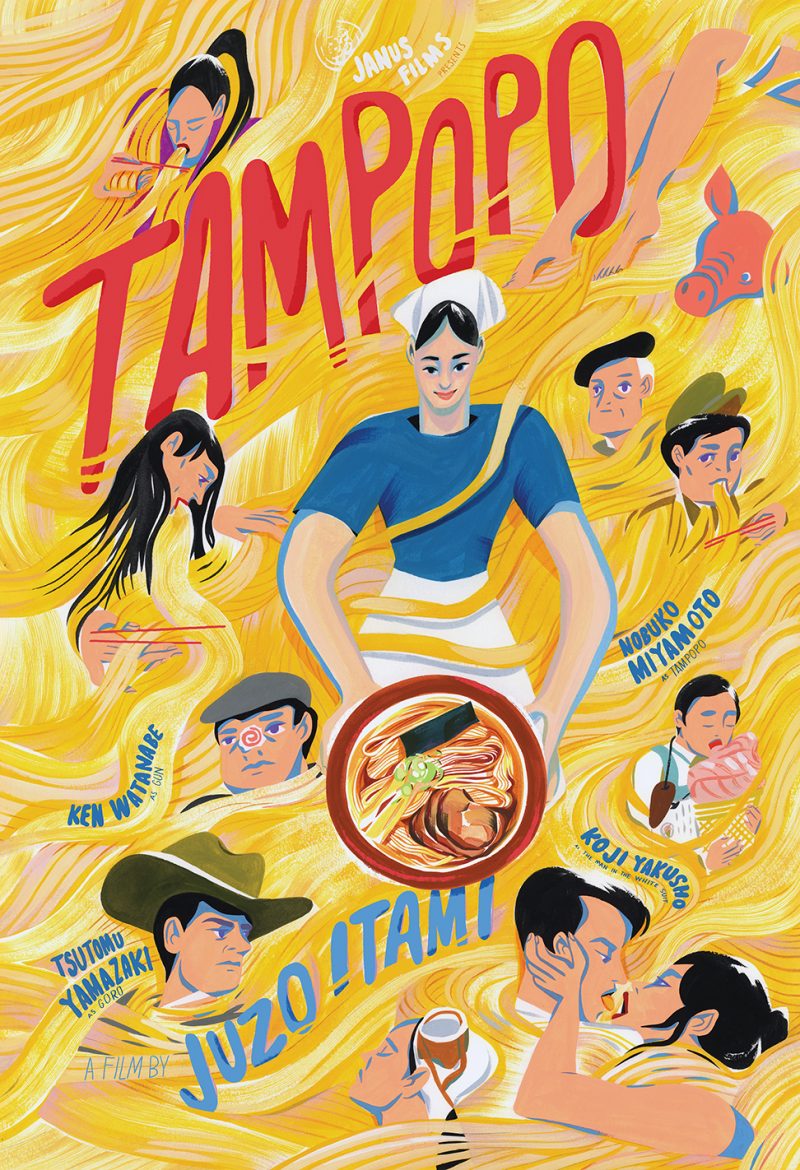
I recently found myself wandering through College of DuPage’s (COD) DVD section of the library, looking for a few movies that I could amuse myself with through the next couple weeks. While walking the aisles, I spotted a title I’d never heard of – “Tampopo.” The art on the cover charmed me, and I’d had good luck with foreign films before, so I decided to give the Japanese film a shot.
The 1985 comedy intimately shows the connection between food and all aspects of life, from birth to death, the good, the bad and the ugly. While the film is not rated, it does contain some explicit, though artistic scenes, which would most likely earn it a mature rating.
The movie had me captivated before the first real scene started. The movie opens on a vignette, separate from the main plot, where a man in a white suit and his lady sit down in a movie theater and address the viewer directly, warning them against causing disturbances during the film. This breaking of the fourth wall speaks to director Juzo Itami’s intention to communicate directly to the viewers, priming them to hear his message.
The story’s main plot follows “Tampopo,” a single mother struggling to keep her late husband’s ramen shop afloat to support her family. As her business falls into the red, she gains the help of two truckers who stopped in for a meal and promise to make her the best ramen shop in town.
This central plot is charming and has a distinctly western feel to it, with its rough-and-tumble guy rolling into town with his sidekick to shake things up, clashing with local big shots and taking on undercover missions, but the movie really hits home with its often over-the-top vignettes. They appear throughout the movie, with most of them being one-offs. We see more of the man in the white suit and his lady, quite intimately at times, including the closing scene of the movie. The scenes of them sharing food and talking were by far my favorite parts of the film.
I have a long-held belief that food is best shared with others, all my best meals – those I can still remember the taste of today – were shared with my friends and family. Sharing a meal is a moment of vulnerability, respite and an act of care that brings us closer together. A moment of ‘companionship’ – a word that comes from the Latin word ‘companio’ meaning ‘to break bread with another.’
This line of thinking is clearly shared by Itami and his film. Eating is an act that is never taken alone, only shared with others. It is something that is meant to be cherished but never taken too seriously. Throughout the vignettes, the cultural rules that we place around eating are systematically broken down. These scenes show a child whose mother forbids him from eating sweets shares an ice cream cone with an old man. A class on ‘ladylike etiquette’ dissolves into spaghetti slurping after they observe an American businessman doing the same. Eating is not confined to a restaurant or dining room, but happens in a hotel room, at the beach or on a park bench.
Diet culture has been at its worst these last few decades, exacerbated by TV, social media and the introduction of GLP-1 medications, such as Ozempic and Rybelsus. Of these drugs, only Wegovy is approved for weight loss alone, without the presence of type 2 diabetes with another preexisting condition such as heart disease or kidney disease. Despite its intended use as a potentially life-saving medication for those with diabetes, organizations such as The Professional Society for Health Economics and Outcomes Research (ISPOR) are seeing an increasing amount of off-label prescriptions for GLP-1s. In 2023, it was estimated that ~27% of Ozempic prescriptions were off-label.
The overuse of these medications is proving to be a real danger. According to the National Poison Data System (NPDS) GLP-1 overdoses more than tripled between 2022 and 2024, and the numbers have only been climbing since.
This has harmed our relationship with food – which should be innate.
“Tampopo’s” lighthearted approach to food has made me see the ritual of eating in a fresh light. Eat good food, share it with others, eat what you can and want until you are full. Above all else, enjoy the experience.
The film has become my new favorite and go-to recommendation. I’ve since rewatched “Tampopo” twice – on my own and with friends. I would give Itami’s iconic “ramen western” a 9 out of 10. “Tampopo” can be found as a DVD at the COD library, as well as online through a variety of streaming platforms.