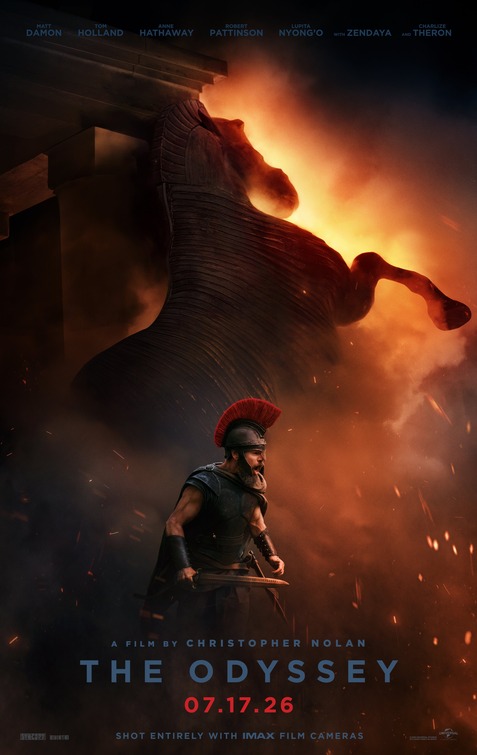
Homer’s “The Odyssey” is a true classic; one of the oldest surviving stories, a paragon of the hero’s journey and a touchstone for Western literature. The epic poem originally spanned over 12,000 lines of text throughout 24 books, now condensed into a nearly three-hour film with a $250 million budget.
Experiencing the film in theaters was mind-blowing – it had me at the edge of my seat, eyes glued to the screen and at times even moved me to tears. It’s clear that a lot of love and attention to detail went into this film. The epic soundtrack, performances, design elements and cinematography all came together beautifully to envelop the viewer in the world of the film. I became so engrossed that I hardly felt the three-hour runtime.
The original story of “The Odyssey” cuts deeply into the hubris of man. The main character, Odysseus, is thrashed against the worst the world has to offer as he fights to get home after surviving a brutal war. On his journey, he loses more and more as he tries to defy the forces of nature, gods and fate itself.
Of course, many details had to be cut from the source material to make the movie work. For those familiar with the original story, perhaps too much. While it has been years since I originally read the book in high school, I felt like unfamiliar viewers might have benefitted from a bit more context surrounding the Trojan War. I also missed some of Odysseus’ iconic moments, such as his parley with the cyclopes. However, I have to acknowledge that the movie was stretched to its reasonable limit, and Christopher Nolan’s adaptation is near perfect given those constraints.
The movie flexed its muscles the most with its cinematography, with Nolan’s choice to shoot the whole movie in IMAX film, having bespoke cameras created for that alone. The special effects are highlighted in many of the story’s iconic scenes – especially when it came to monster design. The giants, cyclops, sea monsters and other beasts fell into their scenes perfectly, unsettling only as befitting monsters. Many viewers were also grabbed by the body horror of a specific scene in the film, where still-living men are shaped by hand into animals.
I was enraptured by the scenes of Ithaca. In any story about war, it is essential to remind the viewer of what is at stake beyond the mortal peril of combat. Robert Pattinson as Antinous and Anne Hathaway as Penelope absolutely steal these scenes, making you feel Odysseus’ absence. We see Ithaca, left in limbo with Penelope looking after her husband’s empty throne, fending off the advancements of greedy and scheming suitors like Antinous.
All along, fate and desire pull Odysseus home. By the time Odysseus returns to Ithaca, that tether is drawn tight in hand and ready to snap. In the halls of his own home, he strings his bow and unleashes the decade of vengeance on those who would take it from him.
“The Odyssey” has a veritable constellation of stars in its cast, to a degree that verges into being distracting. There were times, especially at the beginning of the film, when many characters were being introduced, where recognizing the casting simply brought me out of the moment.
Not, it seems, in the same way many others have been. The film has seen a wave of controversy over the casting of certain characters – namely, prominent transgender actor Elliot Page as Sinon. Based on what people have been saying online, you might expect Page to have a significant role in the movie, a trans man trying to depict a “pinnacle of masculinity.” In the end, it was a fairly minor role spread among a few scenes that he was not out of place in.
There was also controversy over the casting of Black actors such as Lupita Nyong’o as Helen of Troy. The controversy over historical accuracy in race while casting was also blown out of proportion. The Greeks were very well traveled, and familiar with the peoples of the surrounding lands, including Africa. Many such people came to live in the Greek empires. They did not have the racial hang-ups our modern society does; they were much more concerned with cultural practices than skin color.
These casting choices didn’t detract from the film, and anyone distracted by them is clearly hung up on other things.
In the end, actions speak louder than words. Despite the upwelling of online criticism, “The Odyssey” has already grossed over $264 million in ticket sales and is projected by some to become Nolan’s largest-grossing film.
I preferred the original epic poem over the movie. It’s a literary touchstone for a reason. That being said, I’m rating ‘The Odyssey’ 8.5/10 – a movie worth seeing on the big screen while you still can.