


College of DuPage (COD) administrators and campus planners give students and employees a limited window to influence how classrooms, outdoor spaces and student areas will be redesigned over the next five years.
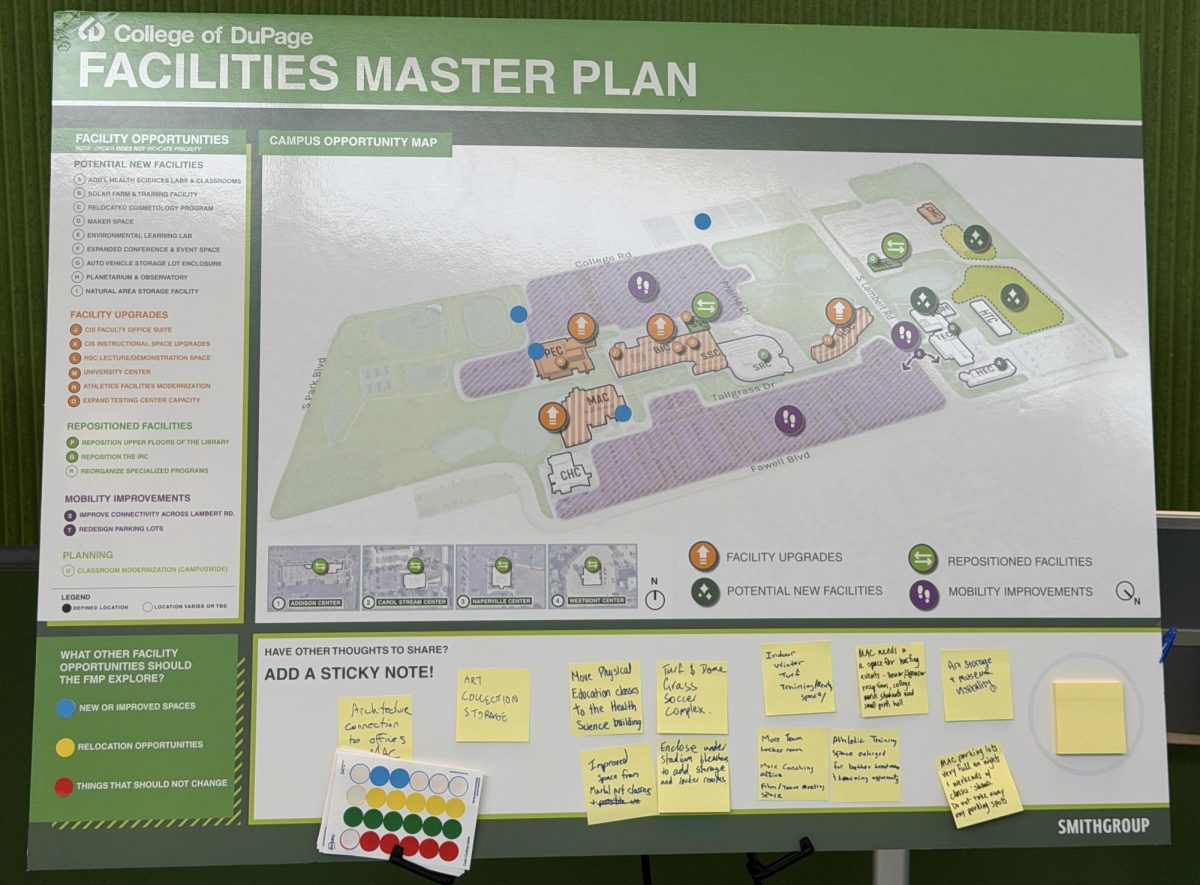
The open forum allowed attendees to review survey findings and campus planning materials. Participants also provided feedback on proposed facility, mobility and space changes.
The Facilities Master Plan, required by the Illinois Community College Board (ICCB) every five years, serves as a long-term guide for how COD’s physical campus will change to meet academic and community needs. The final document must be submitted to the state by June 30, 2026. College President Muddassir Siddiqi emphasized the importance of campus participation in a letter announcing the planning process.
“Your voice will play a vital role in shaping spaces that inspire learning, innovation and belonging for years to come,” Siddiqi wrote.
Architecture firm SmithGroup is leading the nine-month effort, which includes meetings and data collection from October and will continue doing so through monthly engagement sessions before draft recommendations are presented to the college’s board of trustees this spring.
Presentation boards at the forum identified emerging themes for the Facilities Master Plan, including modernized learning environments, improved wayfinding and navigation, expanded student collaboration spaces, enhanced outdoor areas and infrastructure and sustainability improvements. Campus survey findings reinforced these proposed priorities.
In a MapMyCAMPUS survey, results presented during the forum identified six major areas for improvement: study and learning environments, navigation, student support spaces, visitor experience, outdoor amenities, accessibility and safety. William Wellington, senior campus planner with SmithGroup, said the findings reflect priorities raised across the campus community and are intended to guide investment decisions.
“The goal is that everyone here will know what is in the Facilities Master Plan. There should be no surprises at the end; the board of trustees will have seen it and said, these are things that we agree are worthy of investing in,” Wellington said.
Future planning assumptions are based on projected campus use, including an estimated 10% increase in on-campus students and a 5% growth in faculty and staff. Projections will focus on physical campus users rather than online enrollment when determining facility needs, he said.
Alongside the presentation, attendees were encouraged to leave comments on boards about proposed planning themes and ideas for other areas of improvement.
Wellington said the open-forum format is intended to ensure future campus investments reflect broad community consensus rather than individual requests.
“We can’t solve every problem. There might always be inefficiencies, but at least this will be built in a way that everyone will feel some consensus that it’s a worthy project to have in the master plan,” Wellington said.
Potential projects outlined in the Facilities Master Plan raised questions about impacts on tuition or college spending. Wellington said the Facilities Master Plan itself does not commit the college to specific projects or their costs.
“It won’t be like we finished this document and now COD is on the hook for ‘X’ millions of dollars. The board of trustees has to decide that there is funding and desire to move forward,” Wellington said.
Analysis presented during the forum suggests COD may already have sufficient overall building space but could improve how it is allocated. Wellington said planners are examining whether underused classrooms could be used by student organizations or for student collaborations.
“What our initial findings were showing us are, within the walls of COD, you probably have enough space for everything you need, but some of it’s not being used correctly,” he said. “It’s really rethinking existing space.”
State funding for COD facilities currently includes $20 million for temporary facilities replacement and $1.56 million for instructional center noise abatement. COD’s previous Facilities Master Plan prioritized student services improvements, leading to the $28 million renovation of the Student Services Center completed in 2025.
SmithGroup planners said community engagement will continue sending out notices of forums in March and April before draft recommendations are finalized and presented to the Board of Trustees in May.
“March is going to be a big one to get input,” Wellington said. “If you see an event, come out to these events, because this is how we build this plan.”




Nancy Srock • Feb 24, 2026 at 9:57 am
Instead of having the whole campus address as 425 Fawell each building should have its own street address. It would make giving directions to outsiders or emergency responders so much easier.