

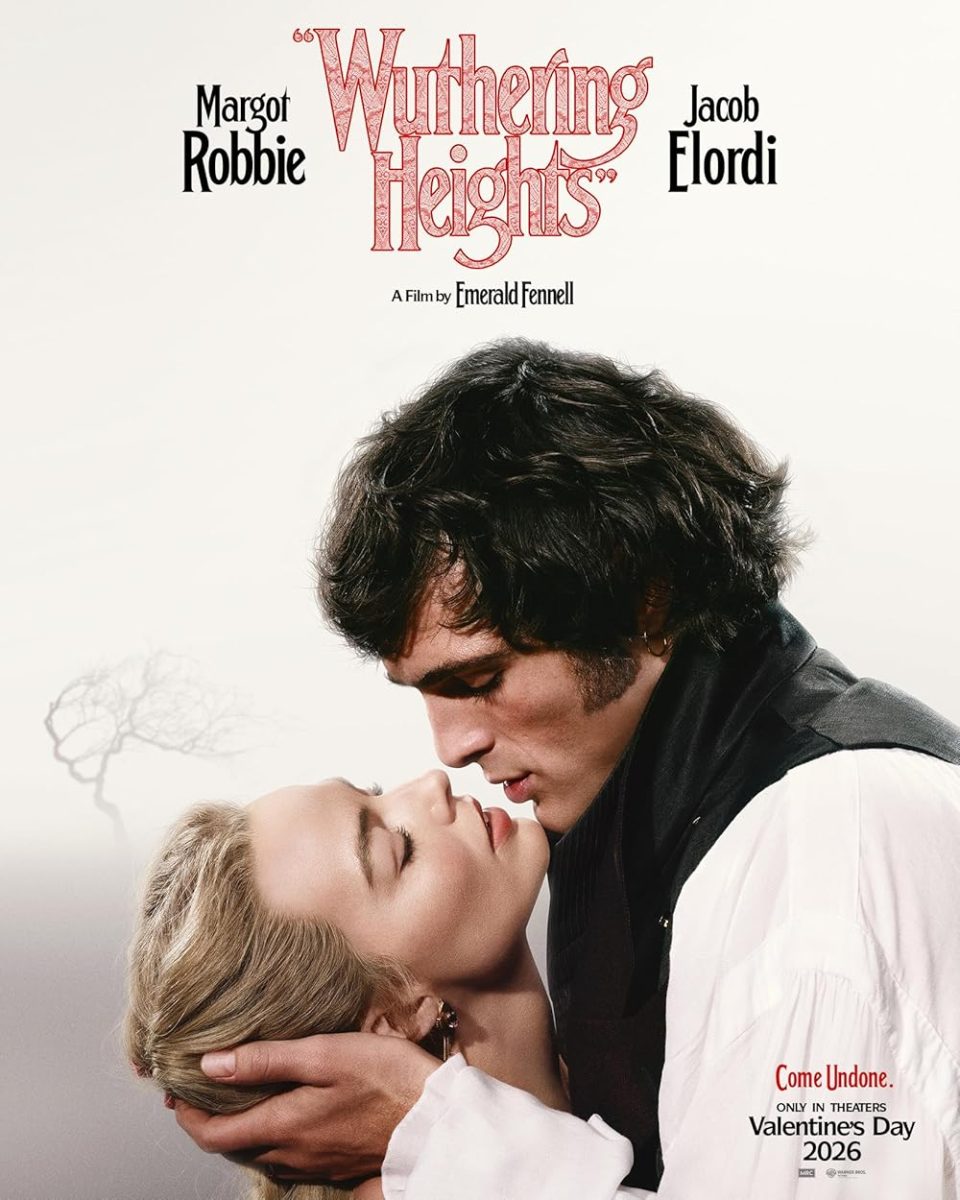
Emerald Fennell has certainly made a name for herself this past decade.
From the provocative “Promising Young Woman” to bold reimaginations in the Andrew Lloyd Webber composed “Cinderella” musical (more commonly known as “Bad Cinderella”), the English actress turned writer director is not shy about making headlines and stirring controversy. On Feb. 13, Fennell continued her reign of unleashing polarizing works with the release of her complete creative and narrative revision of beloved gothic tragedy, “Wuthering Heights.” A bold reimagining that, like “Bad Cinderella,” is exceptional at being bafflingly stupid and embarrassing.
Fennell’s “Wuthering Heights” follows the tumultuous relationship between Catherine “Cathy” Earnshaw and Heathcliff that progressively mutates into one of lust, jealousy and toxicity. Hesitant to be with Heathcliff because of his low social status, Cathy instead marries the wealthy Edgar Linton, which causes Heathcliff to run away and return years later as a wealthy man to torment Cathy. But his return only rekindles the passion the two shared.
One does not need to read Emily Brontë’s original 1847 novel to recognize the film’s large departure from the source material. Admittedly, I had not read Brontë’s novel before seeing the film. However, I doubt her vision had its gothic ambience complemented with a contemporary pop aesthetic, complete with music by electropop artist Charli XCX.
With a stylistic alteration guaranteed to frustrate fans of Brontë’s novel, this pop aesthetic works surprisingly well with the film’s campy tone. The film plays into a meta understanding of the source material and potential fan alienation to subvert expectations and create something new from it. Although inaccurate in source material and period, the film’s production design and dreamy cinematography marry together to deliver a visually gorgeous experience.
But had the film solely adopted this approach to its creative reinterpretation, there could’ve been a dumb-fun film serviceable for its Valentine’s Day, date-night audience the marketing seemed geared towards (even dubbing the narrative as the “greatest love story” in its official trailer). Unfortunately, this film stems from the demented mind of the person who made the gross-out galore “Saltburn.”
Running at 136 minutes, the film is egregiously paced. Even at its lengthy runtime, the film leaves out massive chunks of crucial plot points from the original novel’s narrative. With half the narrative absent, Fennell fills the runtime with a kinky, BDSM-riddled erotica that reads more perverted and cruel rather than tasteful.
The film jumps between these cruel and colorful tones so often that it is guaranteed to make the audience uncomfortable and uneasy. In one scene, you’re watching a campy Disney Channel-esque performance with colorful pinks popping in the background. In the next, you’re mortified by how far and monstrous these same characters are willing to go to satisfy their lustful desires. The twisted sadomasochism Heathcliff inflicts on Isabella to make Cathy jealous is particularly unpleasant to experience. In my packed theater, I found myself and the couples around me groan and cringe from its romanticized barbarism and sexual degradation.
The worst part about Fennell’s “Wuthering Heights” isn’t even its remixing of Brontë’s original text, demented erotic perverseness, jarringly inconsistent tone or cruel nature. It is the fact that every creative decision Fennell makes serves no purpose. Notably, with Heathcliff—although racially ambiguous—being the nonwhite “outsider” in the story, any commentary involving race relations has been omitted. As Fennell cast Australian actor Jacob Elordi, who very much is not a person of color, to play the titular outsider.
To Elordi’s credit, he does the best he can with the material he is given and tries to do so as tastefully as he could, bringing out any resemblance of being the “other” through his performance as the socially/financially inferior Heathcliff. Though, at times, his performance is awkward, trying to seriously deliver bizarrely written dialogue and share scenes with Margot Robbie, who seemingly puts on a childlike, over-the-top theatricality as Cathy.
But even then, any commentary regarding social class has been omitted. Fennell’s screenplay goes nowhere with Heathcliff’s inferiority, apart from being a narrative device to stir drama in the plot. After he becomes wealthy, Fennell’s narrative is no longer concerned with drawing sympathy for the lower class. And Heathcliff no longer becomes an “outsider.”
The film is thematically empty, and any resemblance to thoughtful messaging likely stems from Brontë’s original novel. As even these thought-provoking themes on social dynamics and obsession contradict themselves with Fennell’s desire for a yearning, romantic narrative. Avoiding spoilers, the ending of this film is so far detached from any sense of these themes that I was only left baffled and alienated.
But had Fennell’s creativity served any actual purpose, these seemingly tasteless elements would have synced to deliver a daring, biting vision instead of an offensive, cruel perversion. Although I adored the film’s camp reimagining, Fennell’s “Wuthering Heights” is a shockingly alienating, nihilistic experience. Even as an enjoyer of trash cinema, this movie left too sour of a taste on my tongue for me to enjoy it. My sympathy goes out to anyone who believed this film would have been a good first date movie for Valentine’s Day. Hopefully, your date gave you another chance after that.
1.5/5



Rich • Mar 3, 2026 at 9:41 am
Bro, that movie was hot as f**k. Get over yourself. Took my wife to see it twice.