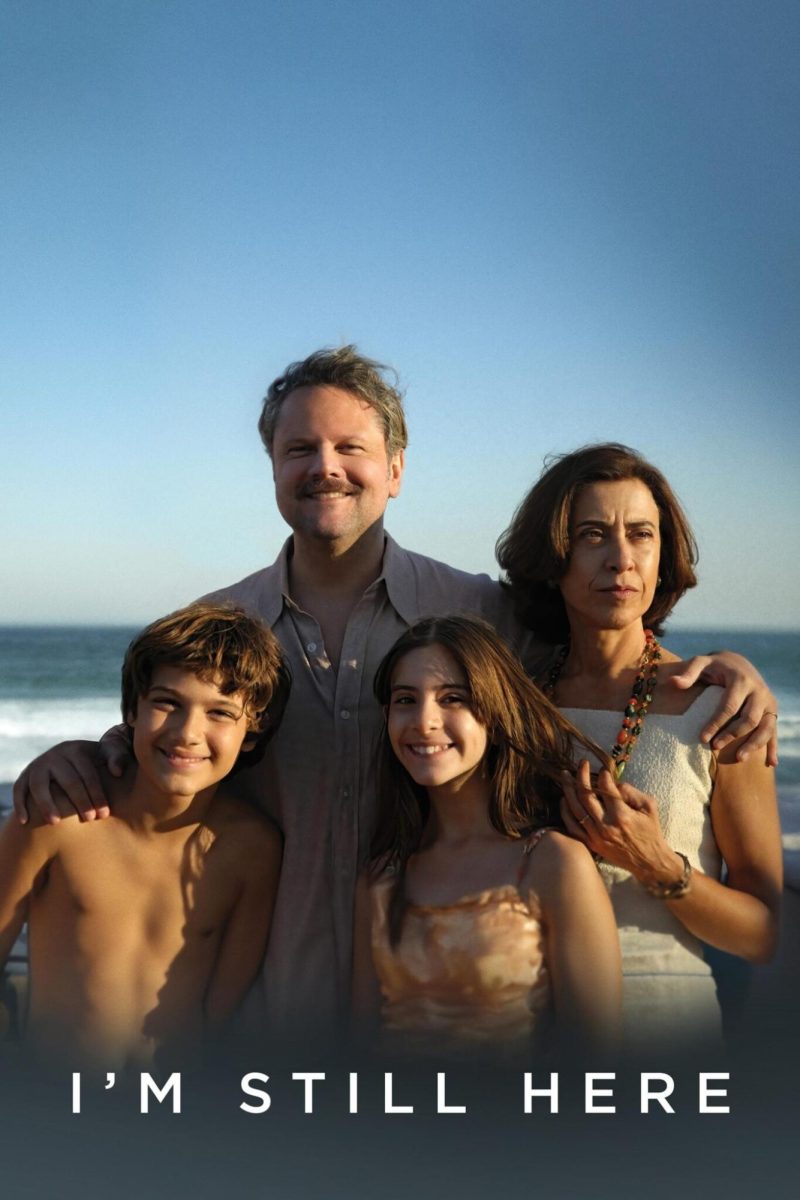
Imagine if, one day, one of your loved ones was arrested on no real charges and never returned. You had no way to prepare or know this was about to happen. To make things harder, your government, the people supposedly responsible for protecting and serving your interests, completely denies that they were ever even arrested. They will not tell you where they are or if they are alive or dead. You dedicate the rest of your life searching for answers while picking up the pieces to your shattered life. For most, this seems like an unimaginable nightmare. Shockingly, this story was the reality of Eunice Paiva, the subject of the 2024 Brazilian movie “I’m Still Here.”
The movie follows Paiva and her family living in Rio De Janeiro in the early 1970s. The family initially lived a happy life despite the growing political tensions and military occupation in the country. One day, Eunice’s husband, Rubens, is taken from their home by federal agents and does not return. Eunice seeks to find out what happened to her husband without further endangering herself and her children.
I was able to watch this movie at the McAninch Arts Center as part of the Global Flick Film Series. Camila Fernández, a faculty member from the Field Studies department, introduced the film and provided some background. I appreciated this, since I knew a bit about the movie’s plot but not a lot about Brazil and its history. The overview of the military dictatorship under Emílio Garrastazu Médici was helpful context to have. She also mentioned how the director of the film, Walter Salles, knew the Paiva family and visited their home as a child. When watching the film, it appeared as if the director had intimate knowledge of the family and their home, so learning this was the case made the viewing experience seem even more personal.
The discussion before the film also brought up several striking points about the movie. This movie could have been made about hundreds, even thousands of other families in Brazil at the time, since the disappearances, murders and systematic abuse of the citizens was so widespread. This is just one story in a sea of many that tries to portray the horrors the country experienced. The fallout from this dictatorship still exists today, with an array of political issues and no real punishment for those who enacted it. The country still suffers from a collective trauma一one that this film seeks to unpack and understand.
This film was nominated for three Oscars at last year’s Academy Awards and even took home the award for best International Feature Film. It’s not hard to see why it received such praise. Fernanda Torres’ performance as Eunice Paiva is both perfectly restrained and tragic. The story hinges heavily on her, so her performance is a crucial aspect of the film, which she delivers on. I mentioned earlier how the director of the film personally knew the Paiva family. The movie introduces the audience to each of the family members and their lives. We see the inner workings of their home, their relationships and their intimate moments. This makes it all the more tragic when their family is fractured. Salles’ ability to get the audience to connect with the characters is a remarkable feat.
The direction itself was also very well done. I noticed multiple shots where characters were shrouded in shadows. This reads as a visual portrayal of the secrets being hidden by the government from the people. People are essentially censored in certain shots because they can disappear at any time. It was a smart, evocative choice. My only real criticism is that the film meanders a bit towards the conclusion. There were multiple times I thought it was going to end before it did. I think the film could have been tighter. Other than that, it was a compelling story based on a great performance and clever filmmaking choices. It is definitely a film I would recommend.
There was also a discussion after the movie where everyone could express their thoughts or ask questions. Multiple people made comparisons of the film’s subject matter to current events in the United States, which stuck out to me. I had not really considered this when I was watching, but after consideration, it was true. The images of people disappearing from their homes, armed military agents patrolling the streets and mass fear and distrust of the government seemed very familiar. This discussion was a really great way to draw these connections; I probably wouldn’t have otherwise.
“I’m Still Here” is a deeply moving story about a woman searching for justice in an uncompromising society. The way I experienced this film provided a lot of necessary context and allowed me to connect the events of the film back to images I’m familiar with in the current world. I take this as a lesson in looking to art to understand the world around us. You never know where you might find meaning.
The next movie in the Global Flick Film Series is “Made in Bangladesh” on Feb. 18. You can find more information about the event here.