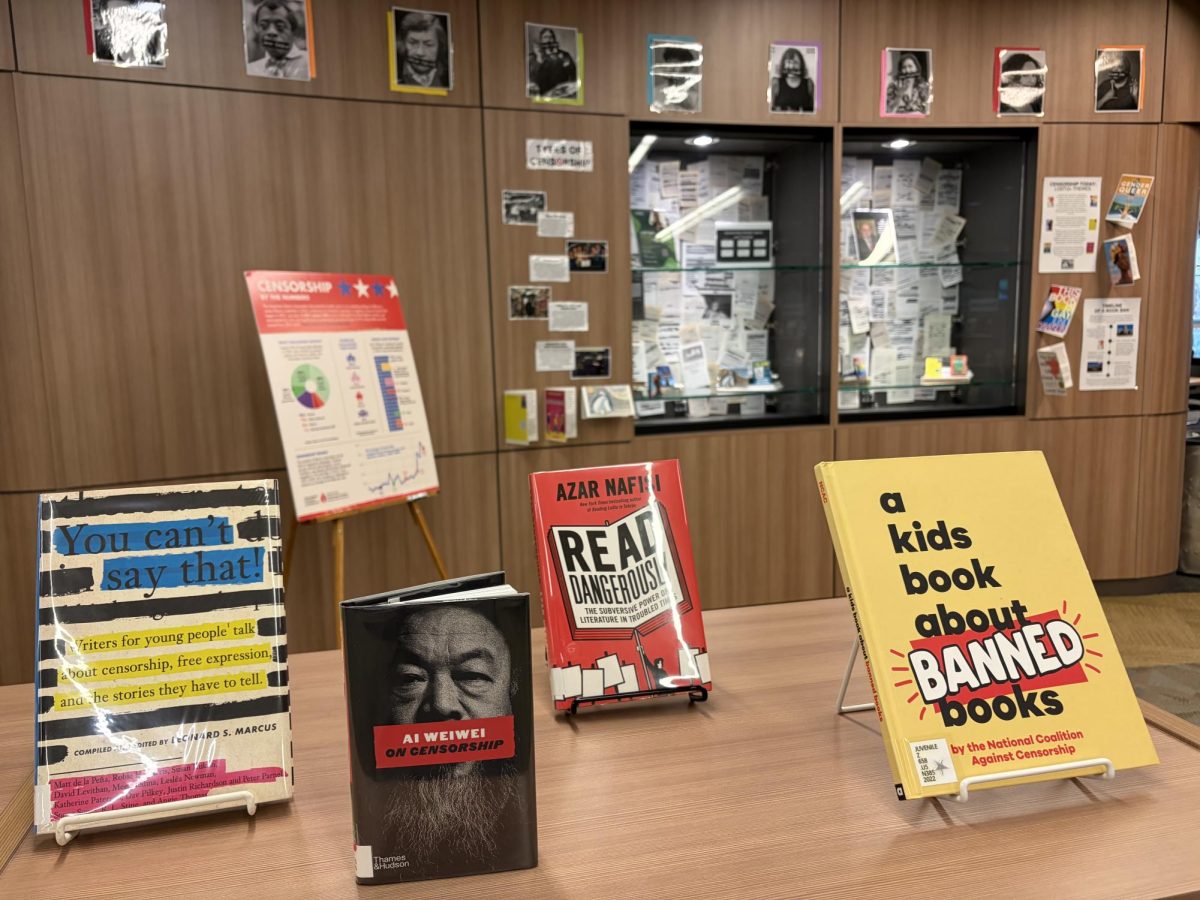
A new year-long censorship exhibit focused on banned and challenged works will debut at the College of DuPage (COD) Library starting this April, offering students and community members a chance to explore how access to information is shaped and restricted.
The “Censorship Today” exhibit will open with an LGBTQIA+ read-in event from 11 a.m. to 1 p.m. on April 15 in COD’s library. To incentivize the read-in, participants can attend a field trip to the Wrightwood 659 art museum for a private tour on April 29. The exhibit will run in the lower half of the library and continue through the 2026–27 academic year with themes that highlight different forms of censorship across literature, art, politics and public health.
Carrie Waibel, reference and instruction librarian, said the idea grew out of years of observing Banned Books Week programming.
“Most libraries in the United States do Banned Books Week every single year. But I’ve worked in libraries for 15 years, and we frequently featured the same slew of books over and over again,” Waibel said.
Waibel said this is the first time they’ve had a year-long exhibit, and the goal is to move beyond a one-week observance and create a space for conversations on an issue that continues to evolve. By expanding the length of the program, the library hopes to give students time to reflect on how censorship impacts the materials they read and the communities they belong to.
“I just knew that this could be something bigger. I felt like if we had more time and attention on it, it could be more impactful with our students instead of being sort of a box-checking exercise that we do every year,” she said.
One half of the exhibit will feature displays that define censorship and show what it looks like both historically and in the present. The other half will change every few months, highlighting books and creators tied to specific themes. Waibel said censorship extends beyond simply removing books from shelves and can take multiple forms that are not always immediately noticeable to readers.
“When we say censorship, a lot of people strictly think of book bans, but they can actually come in several different categories,” Waibel said.
She said materials can be restricted through removal, relocation or limited access. This includes actions such as placing books in sections where they are no longer easily accessible to the public.
“Maybe that means there’s a book on the shelf and maybe a school board, for example, decides to remove it. But another thing that they can do is put it on a reserve shelf, where you’d have to know about it and ask about it to get your hands on it,” Waibel said.
In recent years, attempts to restrict or remove a book based on content concerns have increased. According to PEN America, these titles largely include depictions of sex or feature marginalized identities, such as LGBTQIA+ people and characters or people and characters of color. Kadet Alaks, a reference librarian who helped develop COD’s LGBTQIA+ section, hopes the exhibit will encourage students to think critically about how censorship functions today.
“It’s really important for people to be able to see themselves in books. And it’s important for people not of that identity to be able to read and empathize and learn about different people who are different [from] them,” Alaks said.
Although the COD Library has faced only a small number of formal challenges in recent years, staff said the issue remains relevant locally and nationally. Alaks shared a recent book challenge involving a widely discussed graphic novel that felt especially personal.
“I’m queer, and I like LGBTQ+ books. And there was a graphic novel called ‘Gender Queer’ by Maia Kobabe. When I read it, I found it was very resonant with my experience, so that was a bit close to home,” they said.
The graphic memoir, Gender Queer, written by Maia Kobabe, has been one of the most frequently challenged titles in recent years. It was also questioned within the COD community. While the library ultimately decided to keep it available, the discussion reflected the broader tensions surrounding access to certain materials.
“Someone did write in a challenge about ‘Gender Queer,’ and there were conversations about whether this is appropriate for our shelves. Ultimately, the library decided that, yes, this is appropriate,” Alaks said.
The exhibit is intended to be interactive and responsive to the campus community. Alaks said that engagement can take many forms, from attending programs to incorporating the topic into coursework or simply having conversations about what censorship means.
“I think that’s what’s really great about a college setting specifically, the ability to have hard and complicated and confusing conversations about topics to try and understand them more deeply,” they said.
The exhibit will be located on the lower level of the library and is expected to be installed by the April 15 kickoff. Organizers said its rotating format will keep the space fresh throughout the year, encouraging students to return as new themes are introduced. Waibel said she hopes visitors leave with a stronger appreciation for access to information and the role libraries play in protecting it.
“That free access to information is a privilege that we have, and we should protect it,” Waibel said.