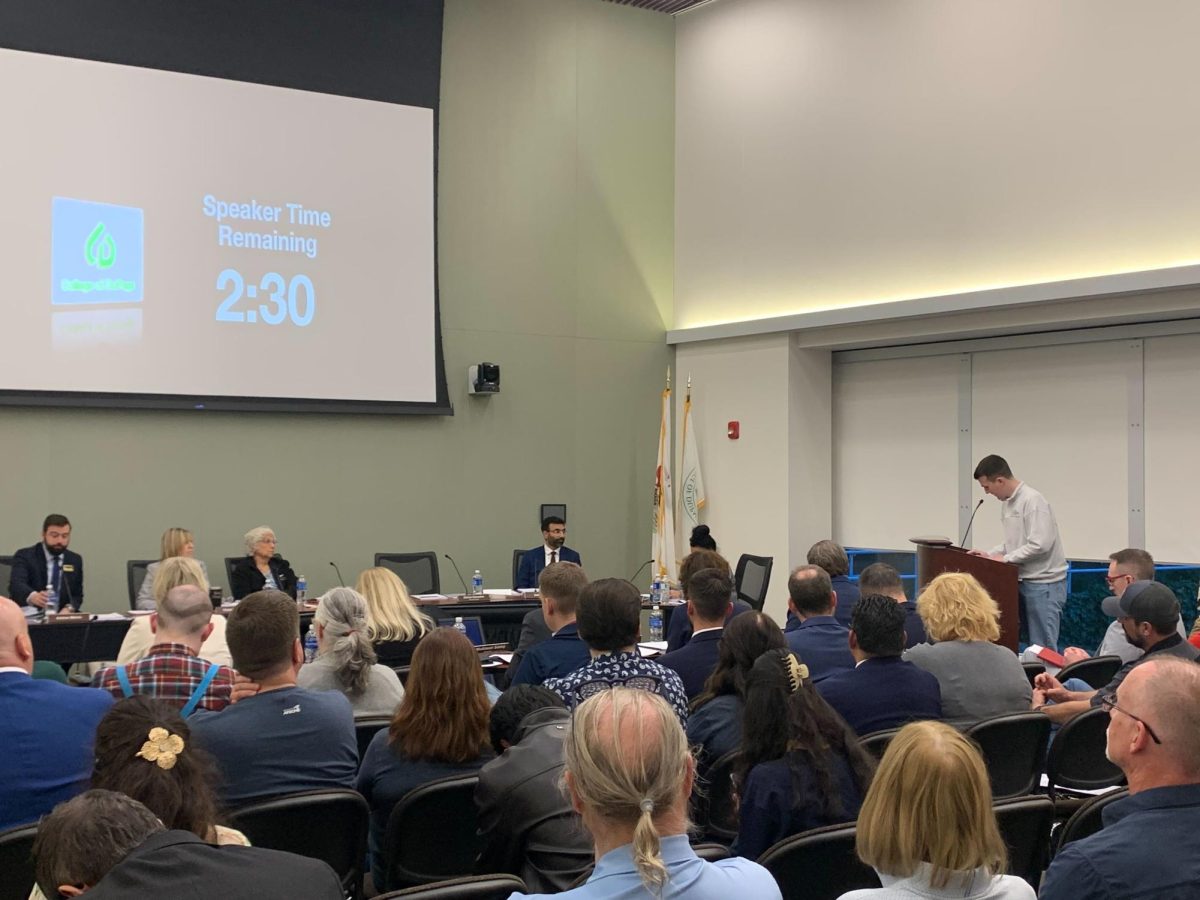
As Generative Artificial Intelligence (AI) tools become more common in education and the workforce, College of DuPage (COD) is drafting a policy that will shape how students and faculty use AI. The proposed policy, presented to the Board of Trustees on March 19, will establish guidelines for the ethical and responsible use of AI across campus, but faculty say questions remain about how those guidelines will be interpreted in the classroom.
To develop the policy, COD President Muddassir Siddiqi appointed a committee of faculty members and administrators tasked with reviewing AI use across the college by gathering feedback from faculty, staff and other stakeholders. The Courier reached out to two members of the committee and received no response.
Siddiqi said the goal is not only to introduce students to AI tools but to help them understand how to use them responsibly in academic and professional settings.
“The purpose of AI literacy is to prepare our students, our staff on fundamental principles, ethical principles,” Siddiqi said. “Whatever we say here in [the] AI policy, you can learn those concepts with examples and collaboration in AI literacy courses.”
The policy lays out a general framework for the use of AI across academic, operational and student-facing areas at the college. However, it does not set detailed rules for how AI should be used in classrooms or day-to-day administrative work. It places much of the authority for implementation in the college president and their designees.
Siddiqi said the flexibility is intentional, and the policy is meant to guide rather than mandate behavior across campus. He said more detailed procedures will be developed as the framework evolves.
He added that classroom decisions regarding AI remain under faculty control.
“There is no administrative mandate on use of AI,” Siddiqi said. “This rests on faculty to decide.”
Faculty members said their ability to determine the use of AI in their classes is important, , but the lack of detail in the policy wording raises questions about how it will be interpreted and applied in practice, particularly as AI becomes more present over time.
Scott Campbell, geography professor and Vice President of the full-time faculty union, COD Faculty Association (CODFA), said one of his main concerns is the document’s use of broad or subjective language.
“What does it mean to ‘encourage responsible experimentation’ with AI?” Campbell said. “[That phrase is] so vague, I don’t even know what that actually means.”
Campbell said AI is already affecting classroom instruction, particularly in assignment design and evaluation. Faculty, he said, are often left to determine whether student work reflects independent thinking or the use of generative tools.
“I’ve had students try to hand in essays that were incredibly vague and obviously artificially generated,” Campbell said. “And I had to tell them, ‘You need to rewrite this.’”
He said that while some instructors use AI detection tools, those systems are not always reliable and can raise concerns about fairness. Faculty often rely on individual judgment when evaluating student work. This approach can vary across courses and departments, leading to confusion, Campbell said.
“They’re not always 100% reliable,” Campbell said. “They also tend to be biased against people who are speaking English as a second language,” he said. “There are all kinds of issues with it.”
David Goldberg, political science professor and president of CODFA, said these inconsistencies show the need for clear boundaries as the policy continues to develop.
“What happens in the classroom should be driven entirely by the faculty,” Goldberg said.
He said that institutional policies must remain strong enough to withstand changes in leadership and evolving technology over time.
“The policy needs to be stronger than the personnel,” Goldberg said.
While the policy outlines how AI should be governed, COD is already expanding access to AI tools and training programs that are shaping how students and faculty engage with this technology on campus, Siddiqi said.
This past fall, the Computer and Information Sciences department launched an AI-focused certificate and degree path aimed at integrating AI into computer science education. In addition, the college has also announced a partnership with Google that provides students and faculty with access to AI tools, such as Gemini and NotebookLM at no additional cost. Siddiqi said the partnership is intended to give students hands-on experience with widely used AI platforms while maintaining data protection. COD is also developing AI-focused training opportunities through Intel as part of a broader push to build AI literacy across the workforce. There is currently no firm start date for the program.
Siddiqi pointed to broader workforce readiness as a driving factor behind COD’s AI initiatives, saying that students will increasingly be expected to understand and use AI tools in future careers.
“If I do not provide you opportunities to learn AI and you go for a job and you have no experience, how can you be a successful employee?” he said.
Alongside institutional partnerships and training programs, the college is also exploring ways to gather student input on AI use and readiness. Siddiqi said an AI-readiness survey is currently in development to better understand how students are already engaging with AI tools and what support they may need.
“I want to incorporate the voice of students in administrative policies and AI framework in the future,” Siddiqi said.
Siddiqi said additional procedures and guidelines for the policy are still in development as the college continues to collect feedback and evaluate AI use across campus. The policy’s implementation date is still uncertain and must go through further review.
To learn more about AI initiatives across campus, visit the COD website.