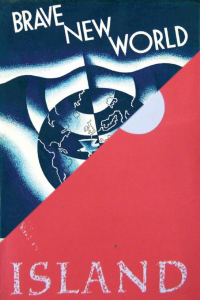
“Attention, attention,” call the myna birds of Aldous Huxley’s book “Island.” “Attention, here and now, boys.” Their message is simple: stop and take in the world around you. Where are you? How are you feeling? What, in truth, is going on?
Huxley’s books were, in many ways, a rude awakening. They aren’t a “fun’ read, but they made me examine many aspects of myself and the world around me in a different light. Because of this, I valued my time. I plan to come back to them someday, this time ready with personal copies and a pen in hand for annotating. Huxley’s two novels work together – one as a warning, one as a possible answer.
“Brave New World” partially foreshadows the island of his later work. In the novel, the main character, Bernard Marx, is threatened with reassignment to Iceland when he fails to fall in line with his place in the system. The island is isolation and rejection; it is where all of the problematic free thinkers of society are sent. Marx, quite out of spirit for his namesake, bemoans this fate. He enjoys all of the excesses and easy comforts of his world and fails to find sufficient reason to break away from it.
In “Island,” the reader finds themself not in Iceland but the fictional island-country of Pala. Their society is unlike anything else in the world. It blends the traditional and modern into something wholly new. The people of Pala have been largely cut off from the rest of the world and enjoy many freedoms, of religion, of family and of lifestyle. They see themselves as living in tandem with nature and as a part of it. They aim to enjoy life—not in the blatant hedonism of the World State but with balance and responsibility for the present and the future. Island calls the reader to examine the shortfalls of the Western world and ask, “What can be done?”
Both because of their chronological order and the fact that the latter is far more popular, most people come to Huxley’s “Island” after reading his “Brave New World.” I ended up going about it backward—I picked up “Island” after seeing a brief internet recommendation, knowing nothing about the author or its broader context. Reading the book felt like a breath of fresh air and made me deeply curious about Huxley and his background. I had to know more.
I was surprised to learn that “Island” came out over 60 years ago, in 1962. To me, it reads much closer to modern day with its group living, open relationships and advocacy for the power of spirituality and psychedelic drugs. “Brave New World” is similar in that way, though I’m still not sure if that says more about Huxley’s writing or the world we live in. That book is even more archaic, coming out 30 years earlier in 1932.
Unlike the usual call-and-response relationship I’m used to seeing in duologies, Huxley’s books form a response-and-call.
“Brave New World” is Huxley’s response to the post-World War I world, with all the excess, complacency and hedonism of the Roaring Twenties. His dystopian world takes these traits to their extremes. It presents people stripped of their individualism, reliant on consumerism, comfort and the caste system to direct their lives for them.
It drives home the point that our minds are far more malleable than many would be comfortable admitting. The people of the singular World State government of “Brave New World” are engineered and conditioned to fit their role in the caste system and society. They are treated both as animals and wholly separate from nature. Conformity and uniformity are not only the expectation but the rule.
The philosopher Socrates likened himself to a horsefly, whose purpose was to bother and rouse the state into action, which had grown slow due to its size. With his works “Island” and “Brave New World”, Huxley plays the role of the horsefly, landing upon various aspects of society and, with measured sharpness, bringing the readers’ attention to them. They are books designed to make you uncomfortable.
Huxley’s messages hit me hard. It seems remarkable that the world he presented over 90 years ago seems so familiar. Certainly, many of his predictions have manifested – we have the designer babies, the increasing consolidation of power and the commitment to production and consumption that narrows the natural world each year. Amid it all, our freedoms are on a backward slide – the United States went from a 0.93 to a 0.83 in the Human Rights Index in just the past year. I see time and time again that there are things deeply wrong with the way our society works. How much can I swallow just to continue to fall in line with society?
I’m certainly a creature of comfort myself. One of the most striking aspects of “Brave New World” was the rampant consumerism. Every aspect of life for the modern people of the World State is designed around consumerism and pleasure. This is reflected in our modern world. I often find myself frozen by the mere thought of how much of the world I touch is controlled by people I’ll never meet –people who do not and would not care to know me. How much of my life is dictated by my statistical profile feeding into an algorithm? Despite these terrifying thoughts, I struggle to reduce my level of consumption – digital, monetary, sweets or other vices.
While reading “Brave New World,” I often found myself feeling defensive, rejecting Huxley’s assertions of where the world is headed. “The world isn’t actually like that; people would never let it go that far,” I would tell myself. And yet, I would have to admit that there was a kernel of truth to it all. “Island” left me similarly shaken, almost incredulous. I pondered, “Is any of this realistic? Is any of it even possible?”
Both stories come from the perspective of a middle-aged man working for the privileged elite, who enters a new world and is forced to confront what that new world brings to light. Both stories showcase a young man torn between worlds. Those being childhood and adulthood, native and colonized heritage, tradition and modernity or desire and chastity. Both works deeply examine the role of drugs, messaging and religion in society. However, while “Brave New World” aims to instill a sense of urgency and alarm about the current course of the world, “Island” is a message of hope for the future – that another path is possible. It was the last novel Huxley wrote, a final message that he wanted to send after his throat cancer diagnosis in 1960.
For now, I’ll keep my answer to Huxley’s question simple. Be kind to others, both the people who are here today and those who will be here when we’re gone. Work with what you can reach instead of trying to solve the whole world. Keep your head up and eyes open, putting one foot in front of the other each day.
I do not believe that we are living yet fully in Huxley’s “Brave New World,” nor do I think that his “Island” is our blueprint forward. It is, however, my sincerest belief that the first step to creating a better world is envisioning one. To that end, Huxley’s books are an important exercise in examination and imagination.
What do you see?