At a time when global conflicts, such as the Israeli and Palestinian War, dominate headlines and social media feeds, many feel overwhelmed — or even hesitant — to engage. United Nations International Children’s Emergency Fund (UNICEF) at the College of DuPage (COD) hopes to change that by creating a space focused not on division but on understanding.
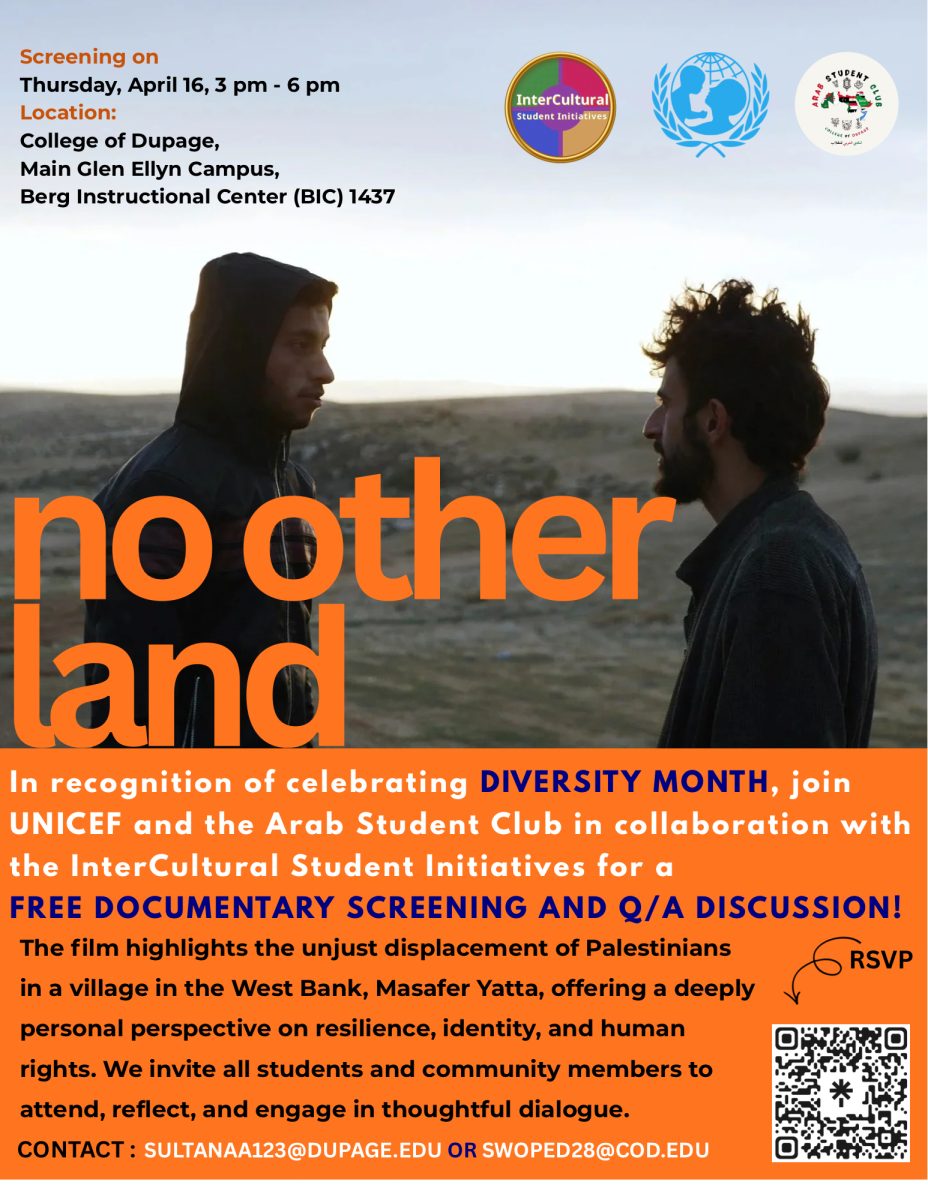
On April 16, 3 p.m. to 6 p.m. in Berg Instructional Center room 1437, COD’s UNICEF UNITE Club (COD UNICEF) will host a screening of “No Other Land,” a film centered on the human realities of conflict, particularly within the ongoing situation between Israel and Palestine. The event coincides with Diversity Month that lands in April — aiming to encourage students to explore global perspectives in a thoughtful, open-minded way.
For COD UNICEF President Anam Sultana, the timing of the event is especially significant.
“This is one of the most talked-about issues currently,” Sultana stated. “We want to bring awareness to it in a way that allows students to be educated and exposed to different perspectives without bias.”
Rather than framing the screening as a political discussion, organizers emphasize education and critical thinking. Attendees will not only watch the film but also hear from Professor Deborah Aldelman, a former Film Studies faculty member who represents the Jewish perspective. The second speaker, according to Sultana, may be Sawsan AbuBaker, part of the Advocates for Justice, however AbuBaker’s attendance has not been confirmed at this time. Both speakers will provide insightful information about the film itself, along with the global crises occurring.
COD UNICEF fundraising events chair Rima Shah said many students avoid conversations about global crises altogether.
“There’s a lot of pressure around what ‘side’ people are on,” Shah said. “Students are scared to pick a side — or even to learn about what’s happening. We want to remove that fear. This is about education, not bias.”
By opening the conversation in a neutral and supportive environment, UNICEF hopes to meet people where they are — regardless of prior knowledge or perspective.
“We want to talk to people and understand what they know,” Shah added. “We want to help them learn more without bias coming into play.”
A key goal of the event is to shift how people think about conflict. Rather than viewing war as a distant political issue, organizers want attendees to recognize the human impact behind it.
“Wars are often seen as problems, not as people,” Shah said. “We want to humanize the individuals living through these situations.”
For Sultana, the event reflects the broader mission of UNICEF on campus: to empower, educate and inspire awareness about global issues — especially those affecting children.
“We want people to feel informed about countries that need relief,” Sultana said. “And we want them to take that awareness into their communities and make an impact.”
COD is known for its diverse student body with 29% of students identifying as Hispanic/Latino, 10% identifying as Asian, 7% identifying as Black or African American and 43% identifying as White in 2024, according to the college’s Student Body Characteristics report.
As conversations around global conflict continue to intensify, UNICEF hopes this event will offer something different: a chance to step back, reflect and engage with empathy.
Be sure to attend the screening of “No Other Land” on April 16 from 3 p.m. to 6 p.m. at BIC 1437. To learn more about UNICEF or UNICEF UNITED, check out unicef.org or COD’s Student Organization Page respectively.