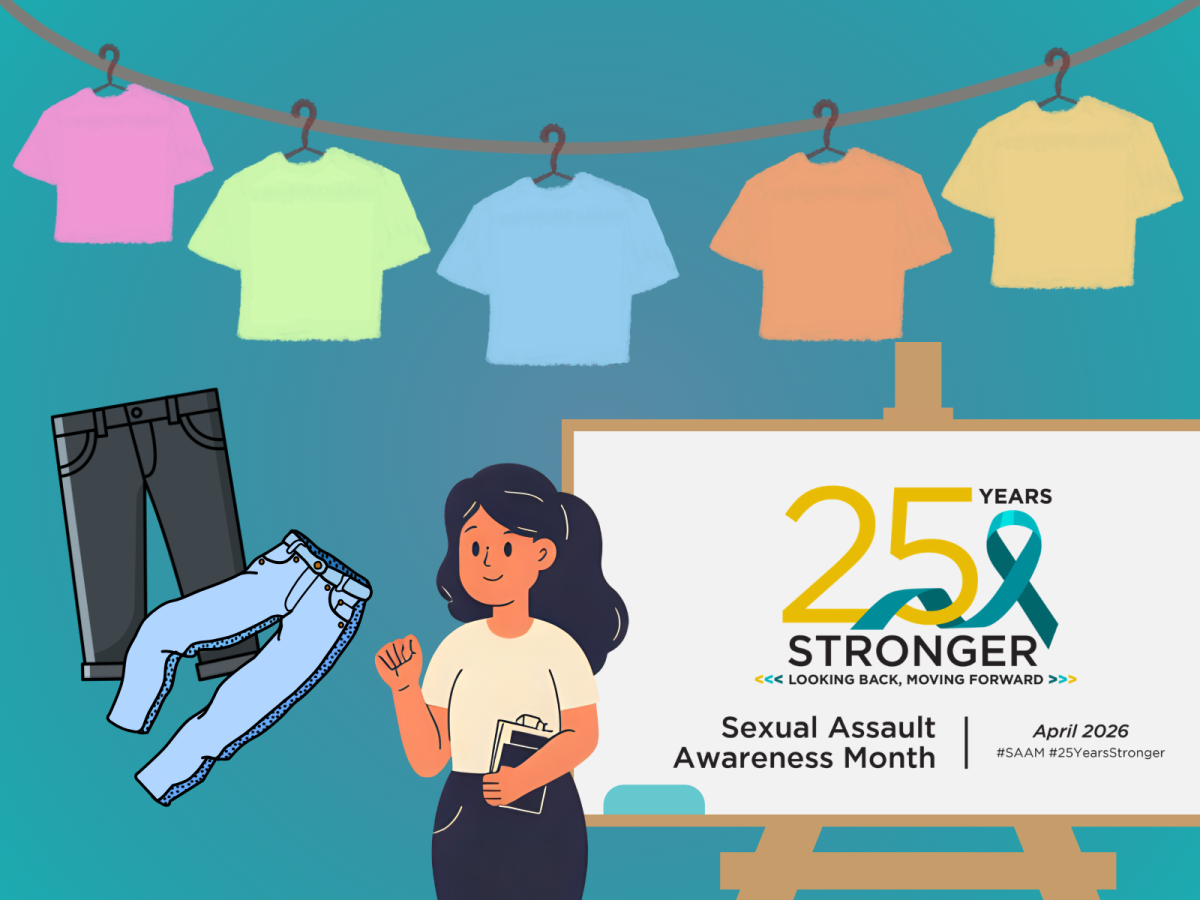
April is Sexual Assault Awareness Month (SAAM). The National Sexual Violence Resource Center (NSVRC) declared April as SAAM back in 2001 to bolster both awareness and prevention of sexual assault, harassment and abuse. College of DuPage (COD) has acknowledged SAAM and taken it as an opportunity to educate students since 2003.
Assia Baker, Title IX and Student Conduct coordinator at COD has been running SAAM since 2023. This year, she led the effort to double down on education and awareness. Usually, the school hosts one or two larger events, inviting a speaker or coordinating more involved learning for the students. For the first time, COD hosted four separate events, one each week of the month. This included inviting two speakers for the Students Fight Back and Sex Rules talks and two involved learning opportunities for students to attend—Denim Day and The Clothesline Project.
During these events, Baker said the college focused on giving students hands-on tools to take away.
“[The] turnout was really great,” said Baker. “Student engagement with asking questions and wanting to know what’s going on really stood out.”
COD has historically partnered with the Young Women’s Christian Association (YWCA) for SAAM. This year, the college also hosted informational and resource booths from the National Alliance on Mental Illness (NAMI), Hamdard Health Alliance and The Prescription Playbook.
Sexual assault, abuse and harassment are topics that are both heavily important and at times difficult to address. It’s an issue that is especially relevant to college campuses. Sexual violence can happen anywhere, according to RAINN, but college campuses present unique “dynamics that can increase risk.”
In some ways, COD, as a community college, has it better off than the typical four-year university.
“Because we’re a commuter campus, we don’t see a lot of things happen here on campus,” Baker said. [But] just because something didn’t take place on campus, doesn’t mean students aren’t still affected by it.”
Sex education throughout K-12 can vary wildly depending on where a person grows up. Despite the many benefits of sex education to “reduce and prevent health problems, unintended pregnancy, mental health challenges and many forms of violence,” according to the Illinois State Board of Education, the topic is largely left in the hands of the parent(s) or guardian(s) of a student.
In Illinois, sex education is required to meet the National Sex Education Standards, but it is up to each school district whether they include it in their curriculum or not. According to the 2024-2025 Comprehensive Sexual Health Education Report, the majority of districts in Illinois choose not to. On top of that, parents can opt their child out of sex education at any point.
COD is in a similar situation, as the law states that there is no obligation for sexual assault education and awareness. Because of their status as a community college, the college does not have to enforce Title IX training for students outside of staff members.
Baker said that while it is not enforced, COD aims to bridge the gaps in understanding their rights.
“[We] provide that extra step to ensure that students have equitable access to the educational environment,” said Baker.
The NSVRC’s motto for the 25th anniversary of SAAM is “Looking back, moving forward.” Upon reflection, Baker explained that sexual assault is still prevalent on college campuses.
“There’s always something that can be done,” Baker said. “Making sure that students are being heard and still have access to what’s important.”
In the future, Baker hopes to strengthen partnerships with COD clubs, sports teams and student leaders in April to bring even more awareness and voices to the table.
COD has many resources for students who encounter trouble with sexual assault. They are free to reach out to Baker at the Dean of Students Office, Counseling Services and the campus Police Department. Additionally, there are emergency call boxes located throughout the exterior of the main campus.
COD offers optional Sexual Assault Prevention for Community College and Title IX training courses, which are sent out to students’ emails. Students can also request safety escorts around campus, especially at night.
Anyone struggling with sexual assault can call the National Sexual Assault Hotline at 1-800-656-HOPE.
For more information on domestic violence, visit the Illinois Coalition Against Sexual Assault’s website or call 217-753-4117.