Editor’s note: This piece has been further edited to correct some spelling after publication.
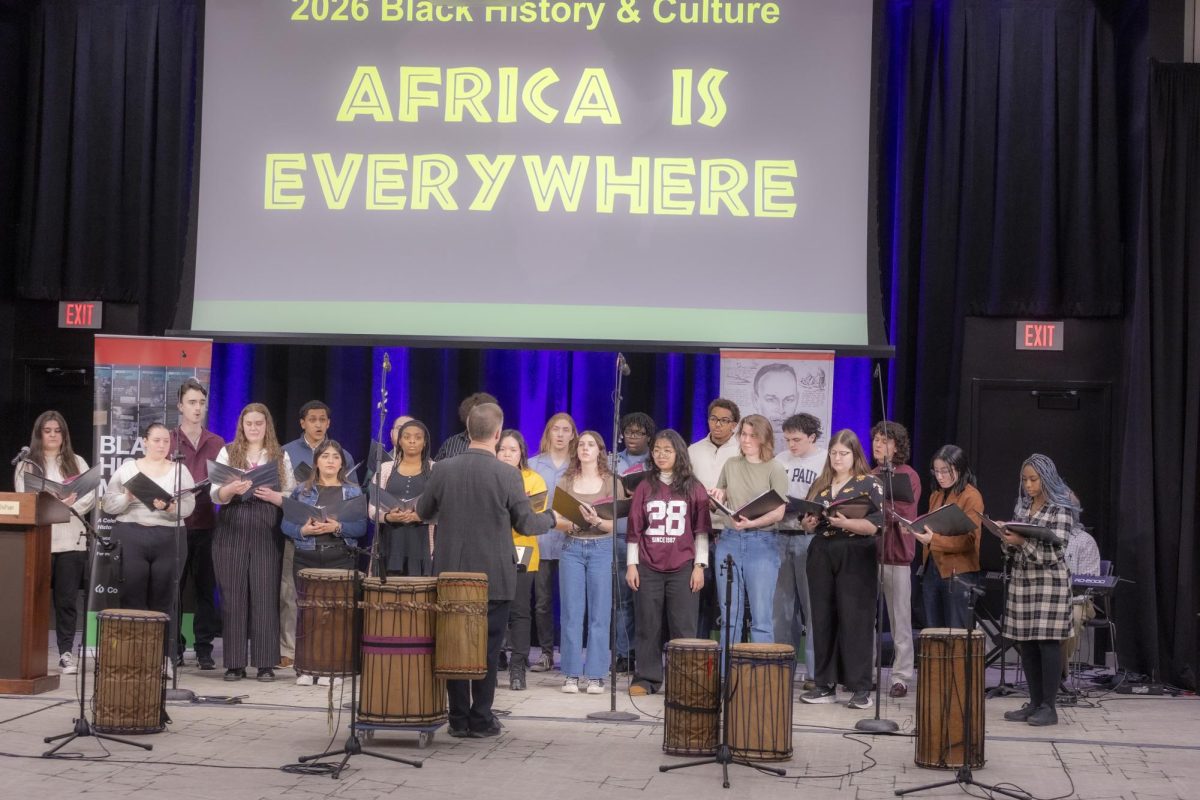
Beginning the opening ceremony of Black History Month, the first notes of the national anthem echoed through the auditorium. Under the direction of Patrick O’Shea, College of DuPage (COD)’s chamber singers filled the space with harmony, setting the tone for reflection, pride and cultural celebration.
After the anthem, COD President Muddassir Siddiqi stepped forward, grounding the audience in the purpose of the month. As he reflected on the role of community colleges, he emphasized belonging and responsibility.
“As a community college, we serve students from every walk of life,” Siddiqi stated. “Our community, our commitment to a culture for care and belongingness calls us to listen, learn, and engage thoughtfully with one another.”
His words lingered一a reminder that Black History Month is not just about remembrance but about action and engagement within our own campus community.
The chamber singers returned to the stage, this time delivering a powerful rendition of the “The Word Was God” by African-American composer Rosanie Powell, followed by the soul-stirring “Total Praise” by Richard Smallwood. The music rose like a prayer, honoring the deep spiritual and cultural roots embedded in African-American history.
However, during this opening ceremony, it was the student voices that truly defined the moment.
Jamiya Haynes, president of the Black Student Alliance (BSA), spoke with conviction about this year’s theme: “Africa is Everywhere.” Her words carried both history and pride.
“To me, Africa is Everywhere speaks to the over 400 years my people contributed to the foundations of this country when they stepped foot on a land they would never get to call home,” Haynes said. “My greatness starts in Africa first. There would be no me without it, and there would be no you without it.”
Jayden Gant followed, speaking about resilience and community.
“The scariest thing about our people is how far behind they forced us to be for centuries, and how far we have made it ahead regardless,” Gant said. “Martin Luther King, Malcolm, Bobby Seale, Huey P. Newton—none of these names would live rent-free in our minds if those people worked alone. It is the communities they lived within and lifted up that made them who they are and who we are.”
His reminder was clear: progress is never individual. It is collective.
Devin Chambers, professor and co-advisor of the BSA, challenged the audience to think beyond surface-level celebration.
“Black History Month isn’t about cherry-pick visionaries or feel-good Martin Luther quotes,” Chambers said. “It’s about unraveling the lies through our actions. Because a house that tells the truth might shake, but at least it can finally stand.”
His words acknowledged both the grief of lost years and the strength required to keep moving forward.
As the program neared its end, Naveen Shabna, vice president of Organizational Development, offered words that carried beyond the walls of the auditorium.
“We know Black history is not limited to a single month. How we show up is a reflection of who we are collectively. May this gathering today inspire all of us to carry that commitment forward.”
Shabna reminded attendees that celebration must turn into a commitment to bringing culture and respect to societies.
Then, the atmosphere shifted.
Members of Ayodele Drum and Dance took the floor, bringing rhythm and motion to the ceremony’s final moments. Before performing, they shared their mission: to study both the music and the dance deeply, ensuring traditions are preserved and shared with respect.
“We study the music as well as the dance so we can continue to spread our culture correctly—and so we can know and respect everyone else as we do.”
The ensemble performed traditional rhythms and dances rooted in West African culture, including Lamba and a presentation of the djembe一a hand-played drum created by the Numu people, historically known as skilled blacksmiths. The layered beats echoed through the auditorium, each note telling a story. A story older than textbooks themselves.
The performance was not just entertainment一it was education in motion, history carried through sound.
As the final beats faded, the ceremony ended in resonance. COD’s Black History Month ceremony was more than a program一it was a gathering of voices, stories and shared history. A reminder that Black history is alive, global and deeply rooted in both legacy and community. BSA’s next event will be Cultural Food Potluck on Feb. 19 in the Student Services Center, Room 1103 at 12 p.m.